
Shuttling – regler og praktisering
Definisjon:
Shuttling betyr at en arbeidstaker bor ett sted og jobber et annet sted, og derfor må reise med helikopter (shuttle) til/fra installasjon. OSA regulerer dette.
OSA 3.21 – SHUTTLING
Hvis en arbeidstaker daglig eller enkelte ganger må reise til/fra installasjoner, og deler av reisen faller utenfor arbeidstiden, betales dette med grunnlønn for 2 timer per dag.
Praktisering med eksempler
Eksempel 1
Den ansatte shuttler begge veier i arbeidstiden.
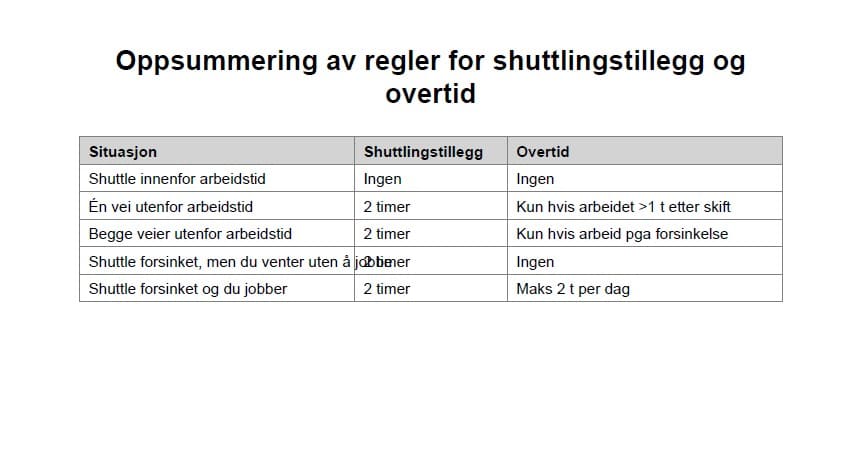
Ingen kompensasjon.
Alt skjer innenfor betalt arbeidstid → ingen tillegg.
Eksempel 2
Den ansatte shuttler til rigg i arbeidstiden, men retur er utenfor arbeidstid.
Her utløses 2 timer shuttlingstillegg.
Returen ligger utenfor arbeidstid → tillegg betales.
Eksempel 3
Den ansatte shuttler begge veier utenfor arbeidstiden.
Shuttlingstillegg på 2 timer.
Begge reisene ligger utenfor arbeidstid, men regelen gir fast 2 timer per dag, ikke per vei.
Overtid i forbindelse med shuttling
Overtid er ikke automatisk knyttet til shuttling – det avhenger av om arbeidstaker faktisk jobber utover skiftet fordi shuttelen er forsinket.
Regel:
Du kan føre overtid kun hvis du må jobbe frem til shuttelen kommer, og denne arbeidstiden overstiger 1 time etter ordinær arbeidstid (dvs. etter 12 timer).
Eksempel på overtid ved shuttling
Eksempel:
Den ansatte må arbeide frem til shuttelen med nytt crew kommer.
Shuttle ankommer rigg 1 time etter skift slutt, og den ansatte har jobbet i hele denne tiden.
Da har man krav på:
• 1 time overtid utover 12 timer, pluss
• 2 timer shuttlingstillegg.
Viktig regel: Maks arbeidstid den dagen
Shuttlingstillegget på 2 timer regnes som arbeidstid i totalen.
Derfor blir maks arbeidstid inkl. overtid 16 timer (12 t + 2 t shuttle + maks 2 t overtid).
Dette betyr at selv om shuttelen er mye forsinket, kan du aldri føre mer enn 2 timer overtid på en dag i forbindelse med shuttling.
Shuttling – Rules and Interpretation
Definition:
Shuttling means that an employee lives in one location and works in another, and must travel to/from the installation by helicopter. OSA regulates this.
OSA 3.21 – SHUTTLING
If an employee, daily or occasionally, must travel to and from installations (shuttling), and part of the travel falls outside working hours, this is compensated with 2 hours of basic pay per day.
How the rule is applied (with examples)
Example 1
The employee shuttles both ways during working hours.
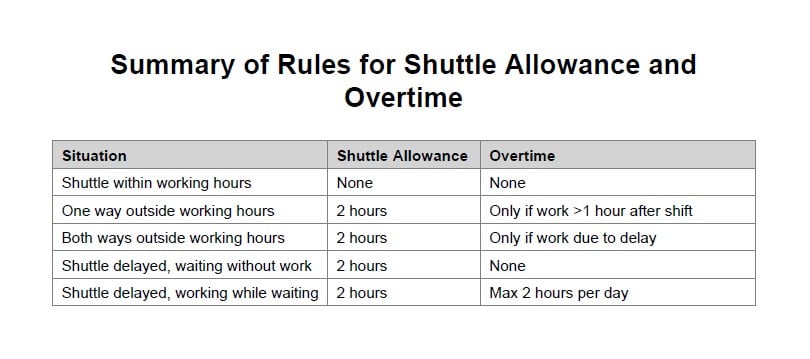
No compensation.
Everything happens within paid working hours → no shuttling allowance.
Example 2
The employee shuttles to the rig during working hours, but the return trip is outside working hours.
The employee receives 2 hours shuttling allowance.
The return trip is outside working hours → the daily allowance is triggered.
Example 3
The employee shuttles both ways outside working hours.
The employee receives 2 hours shuttling allowance.
Even though both trips are outside work hours, the rule grants a fixed 2 hours per day, not per trip.
Overtime related to shuttling
Overtime is not automatically linked to shuttling.
It only applies if the employee must continue working until the shuttle arrives, and this working time extends more than 1 hour past the normal shift (i.e., beyond the 12-hour workday).
Example of overtime due to delayed shuttle
Example:
The employee must continue working until the shuttle with the new crew arrives.
The shuttle arrives 1 hour after shift end, and the employee has worked for that entire hour.
The employee is entitled to:
• 1 hour overtime beyond 12 hours, plus
• 2 hours shuttling allowance.
Important: Maximum hours per day
The 2-hour shuttling allowance is counted as working time.
Therefore, the maximum total hours that can be recorded in one day is 16 hours
(12 h regular work + 2 h shuttling allowance + max 2 h overtime).
This means that even if the shuttle is very delayed, you can never record more than 2 hours of overtime in connection with shuttling.